
The Real Concern Behind the Question
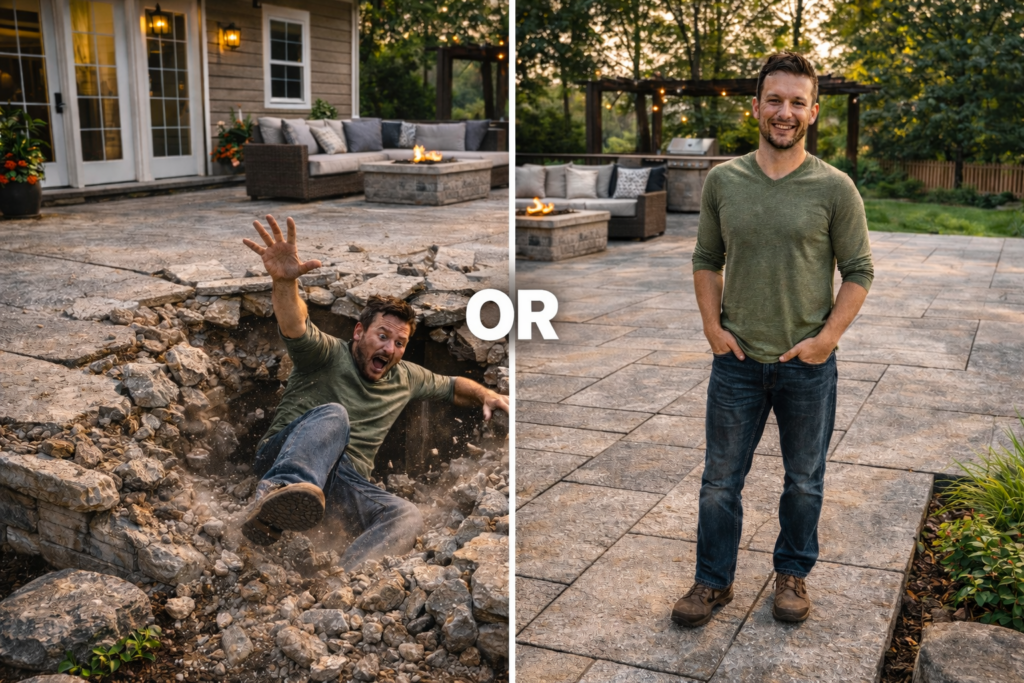
When builders and homeowners hear “stone over a deck frame,” the first concern is almost always cracking.
Stone is traditionally associated with ground supported patios and masonry structures, so the idea of placing it on a framed system naturally raises questions about movement, stress, and long term performance.
The concern itself is valid. Stone is rigid, and framed structures are designed to handle loads through slight movement and deflection. If those two things are not properly accounted for, problems can happen. The key is understanding how modern systems are designed to manage that difference.
Why Traditional Methods Failed
Historically, attempts to install stone over wood framing often led to cracking. That was not because stone cannot work in that environment, but because the installation methods did not account for how a framed structure behaves over time. Wood expands, contracts, and flexes under load, while stone does not respond the same way.
When stone was bonded directly to wood or to rigid substrates that did not allow movement, stress would build up in the material. Over time, that stress would often show up as cracks, loose pieces, or failure in the surface.
That history is what drives much of the skepticism builders still have today.
What Actually Happens in a Proper System
A properly designed stone surface deck separates the structure from the finish. The deck frame still handles all structural loads through posts, beams, and joists, just as it would in any elevated deck. The stone is then supported by a system that is designed to sit above that framing and manage movement and drainage.
Because the stone is not bonded directly to the structure, it is not forced to absorb the natural movement of the frame. Instead, the system allows each layer to perform its role independently. The frame carries the load, while the surface assembly supports the stone in a controlled and stable way.
This approach significantly reduces the conditions that typically lead to cracking.
Movement Does Not Mean Failure
It is important to understand that all structures move to some degree over time. Temperature changes, moisture, and normal use all contribute to small amounts of expansion and contraction. In a properly built system, that movement is expected and accounted for.
Cracking becomes a concern when movement is restricted or transferred directly into a rigid material. When the system allows for that movement to occur without stressing the stone, the risk of cracking is greatly reduced.
This is the same principle used in many areas of construction. Materials that behave differently are separated so they do not work against each other.
What Long Term Performance Looks Like
Over time, a well built stone surface deck should maintain its structural integrity and appearance without the types of failures seen in older installation methods. The stone remains stable because it is supported correctly, and the structure continues to perform as designed.
This does not mean the system is maintenance free. Like any outdoor surface, it will be exposed to weather, temperature changes, and normal wear. However, the goal is to create a system where those factors do not lead to structural issues or surface failure.
According to the Tile Council of North America, allowing for movement and proper drainage is critical to preventing cracking and long term damage in outdoor applications.
When those principles are followed, the performance of the surface becomes much more predictable.
Where Problems Can Still Happen
Cracking is still possible if the system is not installed correctly or if structural requirements are ignored. Inadequate framing, improper spacing, or failure to follow installation guidelines can introduce stress into the system.
This is not unique to stone surface decks. Any material will fail if the structure beneath it is not built correctly. The difference is that stone tends to show those issues more clearly because it does not flex or hide imperfections the way some other materials can.
For builders, this reinforces the importance of proper planning and execution at both the structural and surface levels.
The Bottom Line
The key is not avoiding stone, but using a system that is designed to support it in a framed environment. When structure and surface are allowed to work independently, the conditions that lead to cracking are largely removed.

Stone does not crack simply because it is installed over a deck frame. Cracking is the result of how the system handles movement, load, and environmental conditions. When those factors are addressed through proper design and installation, the surface can perform reliably over time.
If you are evaluating whether a stone surface deck is the right fit for your project, we are ready to help. Visit our contact page and reach out to talk through your questions, your build, and how to approach it the right way from the start.