
What Patching Can’t Fix
When a deck begins to show its age, the first instinct for many homeowners is to repair it. A few damaged boards get replaced, loose railings are tightened, and another coat of stain is applied in the hope that the structure will hold up for several more seasons. While this approach can temporarily improve appearance and safety, it often postpones a larger issue rather than solving it. Before investing time and money into repairs, it is worth considering whether the underlying problem is isolated damage or the natural end of the deck surface’s lifespan.
Wood deck boards take the majority of the punishment over time. Constant exposure to sun, moisture, temperature swings, and everyday foot traffic slowly breaks them down, causing warping, splintering, and eventual rot. Meanwhile, the framing beneath the surface frequently tells a different story. Joists and beams that were properly built with pressure-treated lumber can remain structurally sound long after the boards above them have deteriorated, which means many aging decks have a failing surface while the structural frame itself is still usable.
Why Repeated Repairs Rarely Solve the Problem
Once a deck begins to deteriorate across multiple boards, repairing individual sections rarely stops the overall decline. Homeowners often find themselves replacing a handful of boards one season, only to discover additional soft spots the following year. Over time, the deck becomes a patchwork of new lumber mixed with older boards that continue to age and fail, creating a cycle of ongoing repairs that never fully addresses the core issue.
Even when homeowners decide to go beyond spot repairs and replace the surface entirely, the most common approach is simply installing more wood or switching to composite boards. While composite materials extend the life of the deck and reduce maintenance, they still function as exposed deck boards and eventually experience wear from the same environmental conditions. As a result, replacing wood with another decking material often leads to the same long-term maintenance cycle that homeowners were trying to escape in the first place.
A Smarter Upgrade for Aging Decks
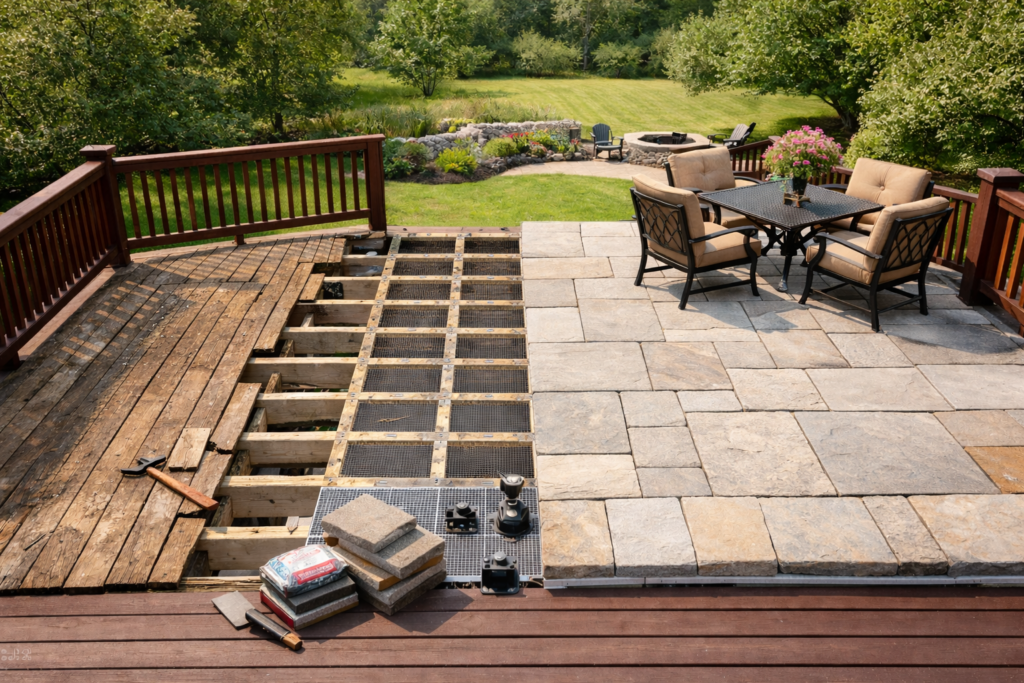
If the structural frame of the deck remains in good condition, tearing down the entire structure is not always necessary. Instead of rebuilding the same type of deck again, homeowners have the opportunity to upgrade the surface completely. This is where the StoneDeks system offers a different path forward, allowing real stone, porcelain, or pavers to be installed over standard deck framing without requiring a full demolition.
StoneDeks transforms the character of an existing deck by replacing aging wood boards with a solid stone surface that is designed for long-term durability. Rather than dealing with splintering boards, constant sealing, and repeated repairs, homeowners gain a surface that looks more like an elevated patio while still using the structural frame they already have. When properly installed and supported by a sound structure, a StoneDeks surface provides a permanent upgrade that dramatically reduces maintenance while improving both the appearance and longevity of the outdoor space.
For homeowners facing the decision of whether to repair an aging deck, the question should not simply be whether the deck can be fixed. The more important consideration is whether repairing it will only repeat the same cycle again in a few years. In many cases, replacing the surface with a system like StoneDeks offers a far better long-term investment than continuing to repair a deck that was never designed to last forever.